

With 20+ years shaping brands, websites and digital systems for SMEs, Chris has seen how often content underperforms when it lacks direction, structure and proof. This article is based on the patterns HeightOn sees across website reviews, redesign projects and SEO performance work, where AI is rarely the only problem.

A lot of businesses are now using AI to generate website content.
That is not really the problem.
AI can help with research, structure, editing, ideas and first drafts. Used properly, it can speed up the thinking process and help teams organise their content more clearly.
The problem starts when AI becomes the strategy.
When pages are created in bulk, written with no real insight, and published mainly to target search terms, they start to look the same.
Same phrases.
Same structure.
Same promises.
Same lack of personality.
Contents
Google’s August 2026 spam update is another reminder that low-value content is getting harder to hide. Google has not labelled it an “AI content update”, but its wider guidance is clear: content created at scale without genuine value is risky, whether it is produced by AI, humans or a mixture of both.
Google guidance on AI-generated content.
Google spam policies on scaled content abuse.
That is the difference.
AI-supported content can be useful.
AI-generated content without strategy, substance or human judgement is where businesses get exposed.
This article is based on the patterns we see when reviewing SME websites, redesign projects and SEO performance issues – where the problem is rarely AI alone, and more often a lack of direction, structure and useful proof.
On AI Content: the tool is not the problem
There is nothing wrong with using AI as part of your content process.
It can help you explore topics, organise ideas, summarise research, compare angles, develop outlines and sharpen drafts. For busy SMEs, that can be genuinely useful.
The issue is not the tool.
The issue is using it without the knowledge and experience needed to guide it.
If AI is used to create pages without clear positioning, customer understanding, expert input or proper page structure, the result is usually thin content with a polished surface. It may read fluently, but it does not say anything meaningful.
And that is where many businesses are vulnerable.
Because content does not perform simply because it exists. It performs when it helps search engines understand your business and helps real people make a decision.
Before publishing AI-assisted content, ask: does this page add something specific, useful and true to the topic and to our business – or could it belong to anyone?
On Google’s spam update: low-value content is getting harder to hide
Google’s August 2026 spam update ran over several days in August.
That matters because search engines are getting better at identifying content that feels automated, adds little value and exists mainly to manipulate rankings rather than help users.
This does not mean every AI-assisted page is a problem.
It means businesses need to be careful when AI is used to produce content quickly, repeatedly and without real value being added.
That is especially important for service businesses, where trust, expertise and clarity matter. A page about a construction company, recruitment agency, marketing service, IT and telephony provider, or property surveying firm cannot simply sound “about right”. It needs to show that the business understands its customers, its market and the decisions people are trying to make.
Generic content struggles because it gives users very little reason to choose one business over another.
On Mass-produced content: more pages does not mean more visibility
Mass-produced content usually starts with good intentions.
A business wants to rank for more services. More locations. More questions. More buyer searches.
So pages get created quickly.
One for every service.
One for every town.
One for every possible variation of a keyword.
On paper, that can look like progress.
In reality, it can create a website full of weak pages that overlap, repeat themselves and fail to say anything specific.
That creates three problems.
First, users do not get a clear answer. They land on a page that sounds broadly relevant, but it does not feel useful, grounded or convincing.
Second, search engines struggle to understand which pages matter most. If everything is similar, nothing stands out. More to the point, many of those pages may struggle to rank at all.
Third, the brand becomes harder to trust. When every business says the same thing, the one with clearer positioning, stronger proof and better structure usually wins.
That is why AI content needs direction. Without it, you can end up with more pages, more overlap and less clarity for both users and search engines.
For the bigger picture, start with HeightOn’s SEO strategy guide. It explains how strategy, structure and authority work together to build long-term search visibility.
On Low-value AI content: polished does not mean useful
Low-value AI content is not always badly written.
That is part of the problem.
It often looks clean. It uses the right phrases. It covers the obvious points. It may even be grammatically polished.
But it feels empty.
You see it when a page describes a service without showing any understanding of the customer’s real problem. You see it when every paragraph could belong to any business in the sector. You see it when there is no opinion, no proof, no local context, no specialist knowledge and no reason to trust the company behind the page.
We are seeing this across sectors.
Websites in construction.
Recruitment.
Marketing.
IT and telephony.
Property surveying.
The words may change, but the pattern is the same. The content says something, but it does not reveal anything.
That is not a strong foundation for SEO.
And it is not a strong foundation for brand trust either.
Brand trust matters because people do not choose a business just because a page appears in search. They choose the business that feels clear, credible and relevant to their situation.
Search engines are looking for similar signals. They need to understand what your business does, whether your content is useful, whether your pages are consistent, and whether there is enough substance behind the claims being made.
Generic AI content weakens that. It can make a business sound visible but not valuable. Present, but not persuasive. Indexed, but not chosen.
That is why stronger content needs more than keywords. It needs clarity, proof, experience and a point of view that feels true to the business behind it.
On better AI content: human thinking comes first
Better AI-supported content starts with human thinking.
Before a page is written, there should be a clear reason for it to exist.
- Who is it for?
- What decision does it support?
- What search intent does it answer?
- What does the business know that a generic article would miss?
- What proof points can be added?
- Where should the page sit within the wider website structure?
AI can help shape the content, but it should not define the strategy.
A good page still needs a clear purpose. It needs a strong heading structure. It needs useful answers. It needs internal links that guide people to the next step. It needs examples, proof and language that sounds like the business, not the internet.
Good AI-supported content is not just written. It is connected – to the brand, the website structure, the customer journey, the search intent and the proof behind the business.
That is where human judgement matters.
AI can help produce content.
Strategy decides whether that content deserves to exist on the website – if at all.
On SEO Strategy: why structure matters more in the AI age
Search is changing quickly. If your website is not adapting, it risks being left behind.
People are not only comparing blue links in search engines anymore. They are seeing AI Overviews, asking questions in ChatGPT, using tools like Gemini and Perplexity, comparing reviews in Maps and making decisions across multiple digital touchpoints.
That does not make SEO less important.
It makes strategy more important.
Your content needs to be clear enough for search engines to understand, structured enough for AI systems to summarise, useful enough for people to trust, and distinctive enough for your brand and business to be remembered.
That does not happen by churning out content for the sake of it.
It happens by building a clearer structure – a content system designed to strengthen authority around the topics that matter most.
Our guide to AI search and generative discovery explains how AI Overviews, ChatGPT, Gemini and Perplexity are changing how people find and compare businesses.
Clear page purpose: every page needs a job
Every page should have a job.
Some pages are built to explain. Some are built to convert. Some support local visibility. Some strengthen authority. Some help users compare options before they enquire.
When a website lacks direction, those roles blur. Service pages become vague. Articles compete with each other. Location pages repeat the same copy. Case studies sit disconnected from the main buying journey.
A stronger SEO strategy makes each page more intentional.
That helps Google understand the site.
It also helps users move with more confidence.
Useful answers: go beyond the obvious
AI-generated content often answers the obvious question, but misses the useful one.
A user does not only want to know what a service is. They want to know whether it is right for them. What the process looks like. What to expect. What makes one provider different. What proof exists. What happens next.
That is where better content earns attention.
Useful content does not just fill a page. It reduces uncertainty.
It helps people make better decisions.
For more on how page-level clarity works, read our guide to On-page SEO for titles, headings and content structure.
Human insight and experience: show what AI cannot fake
Experience is difficult to fake.
Real businesses have stories, opinions, project lessons, customer objections, sector knowledge and proof from the work they have done.
That is what separates useful content from generic content.
For Randoll Industrial, the opportunity was not to publish more generic engineering content. It was to translate technical capability into clearer positioning, stronger messaging and a digital presence that helped buyers understand the value faster.
For Arnold & Baldwin, the challenge was different. Property surveying depends on confidence, clarity and credibility. Generic content would never have been enough on its own. The brand, website and digital system had to communicate expertise before the enquiry was made.
That is what AI alone cannot give you.
It can help organise the thinking.
It cannot replace the thinking. And it cannot replace the experience behind it.
Technical foundations: make content easy to find
Even good content can underperform if the website underneath has not been designed or built well.
Google still needs to crawl, index and understand your pages. Users still need fast, stable experiences. AI systems still rely on clear, accessible information.
If your site has poor speed, broken redirects, weak crawl paths, confusing canonicals or inconsistent structure, more content will not fix the real issue.
Have pages or content that are not being found? Our guide to technical SEO for performance and crawlability explains what to check when content is not being found, indexed or trusted properly.
That is why technical SEO should not be bolted on after the website has been built. Thorough design, build and testing before launch are critical to a successful website.
In fact, technical SEO should be part of the build from the very beginning.
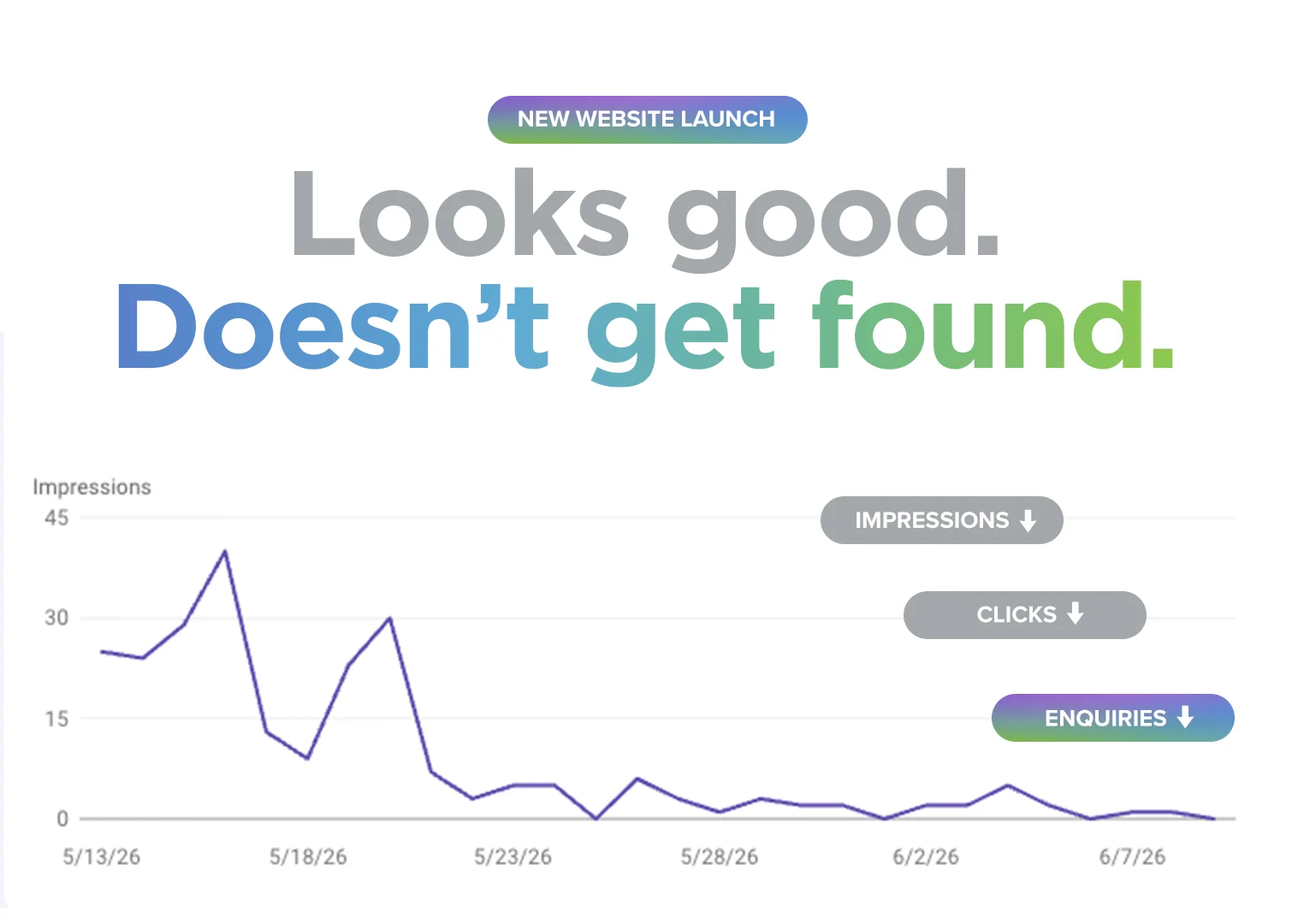
We see this often. A business rebrands or launches a new website expecting better visibility, but the technical foundations are missed. The result can be a good-looking website with weak SEO – or, worse, a redesigned website that loses the impressions, clicks and performance it had already built.
If that sounds familiar, read why a website redesign can affect SEO and what to check before or after launch.
Smart internal linking: connect content into the wider system
Content does not work properly on its own.
You cannot simply publish a blog or article and expect it to rank in Google Search. It needs to connect to the wider website structure, support the main topic, and guide users towards the next useful page.
That is where internal linking matters.
Internal links help users move from one useful page to the next. They also help search engines understand which pages are most important, how topics connect, and where authority should flow across your website.
But internal linking should not be random. It should form part of a wider SEO and topic strategy, connecting articles, service pages, case studies and location pages into a stronger system.
Without internal linking, even good content can become lost and never found.
With smart internal linking, content starts to build authority.
This is often referred to as Link Juice – the way authority and relevance move through your site through clear, considered internal links.
Our Link Juice guide explains how smart internal linking and SEO authority help your most important pages perform.
That matters even more when AI is involved, because a clear structure makes it easier for both search engines and users to understand the role each page plays.
A recognisable tone of voice: sound like your brand
One of the biggest problems with AI content is sameness.
And in the last few years, too many websites and social channels have started to sound the same.
The writing is smooth, but it has no edge. No personality. No point of view. No sense of the brand behind it.
That is dangerous because brand trust is not built by sounding like everyone else.
Your tone of voice should help people recognise how you think. It should reflect your standards, your values and the way you solve problems.
For HeightOn, that means clear, practical and confident content that joins the dots between brand, website performance, search and customer journeys.
Not content for the sake of content.
Content with purpose. Content that’s On Point.
And tone of voice starts with defining your brand, your position and how you are different from everyone else.
What this means for SMEs
For SMEs, the message is simple.
Do not panic about AI.
But do not hand your visibility to automation without a strategy.
If you are using AI to support website content, make sure the thinking still comes first. Know which pages matter. Know what each page needs to achieve. Add real expertise. Use proof. Build strong internal links. Keep your website technically sound. Write in a voice that sounds like your business.
AI can help you move faster.
But only strategy helps you move in the right direction.
If your website has recently been redesigned and visibility has not improved, read why a website redesign can affect SEO and what to check before or after launch.
Big On Better means using AI properly
At HeightOn, we do not see AI as the enemy.
We see it as a tool.
But a tool still needs direction.
That is why we build SEO and AI search thinking into brand, website, marketing and digital projects – not bolt it on at the end.
Because the businesses that perform better in search will not be the ones publishing the most AI-generated content.
They will be the ones with clearer structure, stronger authority, better proof and content that genuinely helps people choose.
That is what SEO strategy is there to build.
And that is what we mean by Big On Better.
HeightOn’s SEO strategy guide explains how structure, authority and content clarity work together.
Latest Articles

Using AI for website content? Why SEO strategy still matters

What does a PPC agency do?
Why your new website looks great but still isn’t getting found

Let’s talk – 01435 692 023
Horam, Heathfield, East Sussex





131 trees planted
How we’re making better choices for people, planet and purpose.
On Sustainability – read more
