

Our digital lead, Domonique, is a social strategist and Google Ads–certified expert. Dom helps businesses cut through today’s noisy, AI-driven landscape – bringing clarity, structure and modern search expertise to every strategy we build.


AI search is changing how people discover information. Instead of scanning ten blue links, users now receive instant summaries from engines like Google’s AI Overviews, ChatGPT Search, Gemini and Perplexity. These systems scan multiple sources, extract meaning and generate conversational answers – often before users even visit a website.
Most businesses don’t lose visibility because their SEO is bad – they lose it because the search experience has changed around them. AI systems decide what to show, what to cite and what information becomes the default answer. If your content isn’t structured for AI, it becomes invisible – even if it’s good.
This shift doesn’t replace SEO.
It reshapes it.
Contents
This guide explains what AI search is, how it affects your visibility and how you can structure content so it’s clear, trustworthy and easy for AI systems to summarise.
For an overview of how AI SEO fits within your wider approach, visit our SEO strategy guide.
Below, we break down how AI search works, why it matters and the practical steps that help your content get cited, seen and chosen.
What is AI search?
AI search refers to discovery systems that generate answers using large language models. Instead of presenting a list of results, these systems:
- interpret the user’s intent
- scan multiple websites
- extract key meaning
- combine sources
- summarise responses
Examples include:
- Google AI Overviews (SGE)
- ChatGPT Search
- Gemini Search
- Perplexity
- Bing Copilot
Whether your content is cited depends on how clear, structured and authoritative it appears.
For content-level clarity guidance, see the On-page SEO guide.
Why AI search matters
AI Overviews appear across most informational queries, influencing:
- which brands users see
- how often users click
- which content becomes the “default” answer
- long-term brand visibility
Search behaviour is shifting from:
search → click → read
↓
search → summary → maybe click
You must structure content so it works for both humans and AI systems.
For technical foundations that support AI visibility – such as speed and crawlability – refer to the Technical SEO guide.
How AI Overviews work
Although each AI engine is different, most follow the same pattern:
- Identify intent
- Scan topically relevant content
- Extract the clearest answers
- Combine multiple sources
- Generate a summary
- Attribute citations (only to the strongest, clearest pages)
What does ‘cited’ actually mean?
When an AI system (like Google’s AI Overview or ChatGPT Search) generates an answer, it often displays small source links underneath the summary. These are citations.
Being cited means:
- your page was scanned
- your content was understood
- your explanation was clear
- your information was selected as a trusted source
In practical terms, a citation is the AI-equivalent of ranking.
The clearer and more structured your content is, the more likely you are to be cited – and seen.
AI systems reward content that is:
- well-structured
- answer-first
- semantically organised
- trustworthy
- refreshingly clear
For authority-building best practices, see the Link Juice guide.
Key signals AI systems rely on
Clarity
Short paragraphs, direct answers, clean structure.
Structure
Meaningful H2/H3s, consistent formatting, clear hierarchy.
Authority
Real experience, factual accuracy, confident tone.
Relevance
Pages that stay tightly focused on a single topic.
Consistency
No drift into unrelated SEO topics.
Schema
Structured data supports accurate interpretation.
Internal context
A clearly structured site strengthens trust signals.
For intent alignment – a core AI signal – explore our On-page SEO guide.
How to make your content AI-ready
AI-ready content is:
- easy to understand
- easy to summarise
- easy to trust
Here’s how to achieve that.
1. Lead with answers
Start sections with a clear statement. Expand only when necessary.
2. Use short, purposeful paragraphs
AI models prefer structured blocks of information.
3. Write for meaning, not keywords
AI systems don’t rely on keyword repetition – they rely on clarity.
4. Add real expertise
Brief HeightOn-style insights reinforce trust.
5. Avoid topic overlap across your site
This prevents AI confusion and protects authority.
6. Refresh regularly
AI systems prefer current, well-maintained content.
For a deeper view of how structure affects crawlability and rendering, see the Technical SEO guide.
Below are real-world examples that show how AI-ready content differs from traditional SEO writing.
Smarter SEO to
Switch On Success
Let’s build better – 01435 692 023
Practical examples of AI-ready content
1. Lead with the answer
Bad example:
“Page speed is an important topic for website owners, and there are several ways to improve it…”
AI struggles – too vague, the answer is buried.
AI-ready example:
“Fast page speed helps your website rank better and reduces bounce rates. Improve it by compressing images, using caching and removing unused scripts.”
AI loves this – the answer is immediate.
2. Use short, meaningful paragraphs
Bad example:
A long block of text mixing headings, schema and content strategy into one paragraph.
AI struggles – too many ideas in one chunk.
AI-ready example:
“Schema helps AI systems understand page meaning. Use FAQ schema on educational pages and LocalBusiness schema for service-based businesses.”
AI loves this – clean, focused, summarisation-friendly.
3. Write for meaning, not keyword matching
Bad example:
“Google AI search SEO optimisation for AI search SEO is becoming important for AI search SEO specialists.”
AI rejects it – keyword spam = low trust.
AI-ready example:
“AI search systems reward clarity, structure and trustworthy expertise. Your content should focus on answering the user’s question directly.”
AI loves this – natural, semantic, clear.
4. Add real expertise (E-E-A-T)
Bad example:
“Businesses should improve their content for AI.”
AI struggles – generic, no expertise.
AI-ready example (HeightOn voice):
“We audit thousands of pages each year. The ones cited in AI Overviews have three things in common: clear structure, answer-first writing and regular updates.”
AI loves this – strong expertise signal.
5. Avoid overlapping topics
Bad example:
“Here’s how to rank in Google Maps, improve your internal linking and write better meta descriptions…”
AI struggles – too many SEO disciplines in one page.
AI-ready example:
“Keep each page focused on one SEO topic. For example, internal linking belongs in a Link Juice guide. Google Maps optimisation belongs in Local SEO.”
AI loves this – reduces topic drift.
6. Refresh regularly
Bad example:
Content from 2021 with no reference to AI Overviews or modern search.
AI deprioritises it – outdated = low trust.
AI-ready example:
“Review your content every 3–6 months. Update statistics, examples and screenshots so AI systems treat it as current.”
AI loves this – freshness = relevance.
Structured content & semantic clarity
Once your content is structured clearly, semantic signals help AI engines interpret meaning and decide whether your page deserves citation.
Semantic clarity helps AI search understand topic boundaries.
To improve clarity:
- keep headings meaningful
- structure ideas logically
- avoid mixing topics
- use Q&A-style mini sections
- highlight definitions
- maintain clean formatting
Internal linking further reinforces this structure – explained in depth in the Link Juice guide.
Trust, expertise & Double-E-A-T
AI systems assess:
- Experience
- Expertise
- Authoritativeness
- Trustworthiness
To strengthen these signals:
- write from firsthand knowledge
- avoid generic statements
- give practical examples
- adopt a confident but human tone
- maintain topical depth across your content series
For positioning within a whole-site strategy, revisit the SEO strategy guide.
How AI search affects click-through rates
You may already have seen the “crocodile effect”:
impressions rise
clicks fall
This is one of the biggest shifts in AI-powered search behaviour.
If you want a deeper explanation of why this happens – and how to respond strategically – read our full guide on the crocodile effect in SEO.
This happens because AI systems satisfy the user’s question earlier in the journey.
Your goal is to:
Be cited. Be seen. Be chosen.
Even if users don’t click immediately, consistent AI visibility builds:
- brand familiarity
- Trust
- assisted conversions
- repeat search presence
It’s long-term visibility – not just short-term CTR.
HeightOn Insight
In our experience, the best-performing AI-ready content is not the most detailed – it’s the clearest.
The easier it is for a model to extract meaning from a page, the more likely it is to cite it.
AI Search SEO FAQs
How do I know if my site appears in AI Overviews?
Test queries manually or use tools that track AI Overview visibility. Citations appear underneath the AI-generated summary.
Does AI search replace traditional SEO?
No. AI search relies heavily on traditional signals – especially clarity, performance and authority.
Why are impressions up but clicks down?
AI Overviews answer questions at the top of the page. This increases visibility but reduces click-throughs – the “crocodile effect”.
How do I optimise content for SGE?
Lead with answers, structure your content clearly, use descriptive headings and include FAQs and schema.
Do I need schema for AI SEO?
It isn’t mandatory, but it helps AI systems interpret your content more accurately.
Can AI Overviews harm my rankings?
Not directly. But unclear structure or low authority can reduce your chances of being cited.
If you’re looking for expert help improving your AI Search visibility, explore our SEO services and choose a plan that fits your goals.
Ready to get On?
If you want your content to perform across Google, Maps, AI Overviews and emerging search platforms, we can help you structure your message for modern discovery.
Get On. Be Featured. Stay Visible.
Latest Articles

Using AI for website content? Why SEO strategy still matters

What does a PPC agency do?
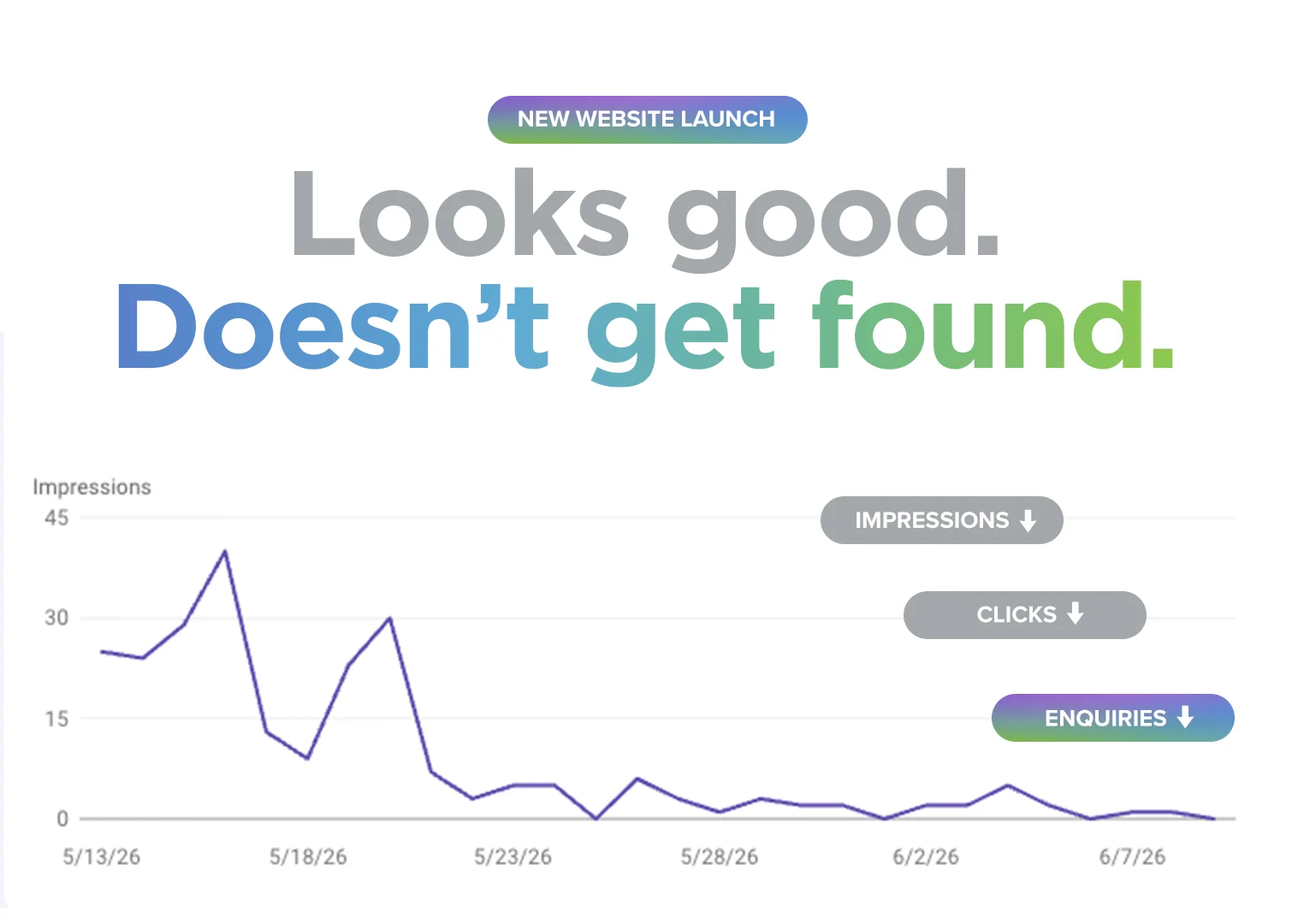
Why your new website looks great but still isn’t getting found

Let’s talk – 01435 692 023
Horam, Heathfield, East Sussex





131 trees planted
How we’re making better choices for people, planet and purpose.
On Sustainability – read more
