


The SEO crocodile effect is real
If your impressions are climbing but clicks are falling, you’re not alone. You’re seeing what we – and a growing number of SEOs – are calling the crocodile effect. It’s the widening gap between visibility and actual traffic, driven by AI-powered search features like Google’s AI Overviews.
Contents
We’ve seen this play out first-hand. And we believe it’s one of the most important shifts in SEO in years. In this article, we’ll break down what the crocodile effect means, why it’s happening, and how we’re adapting at HeightOn – helping others do the same with a smarter, more human SEO strategy.
Did you enjoy this article? Please do leave a Google Review.
What is the crocodile effect in SEO?
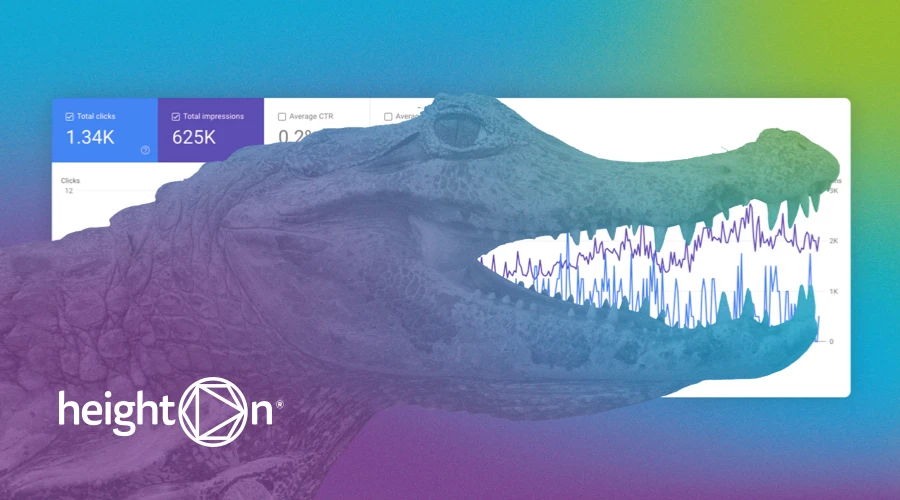
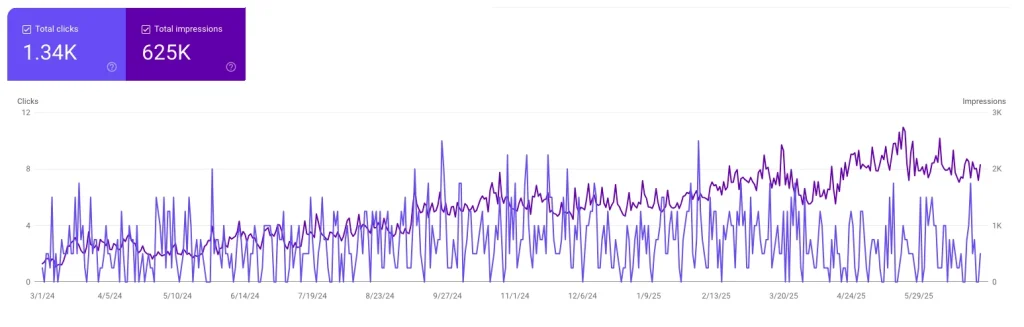
It’s what happens when search impressions rise, but clicks decline. On your Google Search Console graph, it looks like a crocodile’s jaw – impressions rising like the top jaw, and clicks dipping like the bottom.
Why? Because users are getting answers directly in the search results. Google’s AI Overviews surface your content – but don’t always drive traffic through to your site.
“You get visibility – but not traffic.”
This is the classic case of indirect vs direct interaction
Impressions represent an indirect interaction, your content simply appears on a user’s screen, silently racking up numbers. Clicks, on the other hand, are a direct, intentional action. The user has made an active choice to engage with your content, to step through the door you’ve opened. In the age of AI-powered snippets, the door is often visible, but fewer people feel compelled to walk through it.
Impressions vs. clicks: unfiltered exposure meets filtered engagement
This comes down to a crucial distinction:
- Impressions: Each time your site’s link appears in Google search results, whether or not anyone actually clicks it – that’s an impression. It’s a count of visibility, not engagement. Your URL might flash by on page one, or lurk on page three, but every sighting counts.
- Clicks: This is when someone actually clicks your website’s link from the search results. Google Search Console tallies up every direct hit from the SERPs (search engine results pages), but doesn’t count things like redirects or users bouncing around inside your site once they’ve arrived.
The crocodile effect is what happens when Google’s helpful summaries answer users’ questions right in the results, so everyone sees your content, but fewer people click through. The jaw widens: impressions keep climbing, but clicks trail off.
The crocodile effect is not a glitch – it’s the new norm.
Why it’s happening
The crocodile mouth is opening wider – and fast. It’s not a glitch in your reporting. It’s the new reality of AI-driven search.
- AI Overviews generate multiple impressions – even without clicks
- Users get fast answers – and often don’t scroll further
- Clicks are replaced by SERP scanning – quick decisions, fewer visits
What does this mean in practice? “Total clicks” – as tracked by Google Search Console – counts the number of times someone actually clicks your website’s link from the search results page. It’s a straightforward number: see the link, click the link, that’s one click. No bonus points for clicking around inside your site or getting redirected somewhere else. Only that initial leap from Google’s results to your site counts.
But here’s the twist: users don’t click as much as they used to. Instead, they rapidly scan the search engine results page (SERP), make split-second judgments, and often get what they need without ever visiting your site. So while “total clicks” gives you a clean metric for direct interest, it’s also a stark reminder, people are making up their minds faster, and fewer of them are actually stepping through your digital door.
- If your site isn’t AI-optimised, you’re invisible – even if you rank
And we’re not alone in seeing this:
“I’ve seen clicks declining, while impressions stay the same or seem to climb. This has everything to do with new user behaviour on the SERP.”
Lex Gabrees
“The crocodile is making me suffer. My client pages get loads of impressions, but new followers have plateaued.” – Mostafa Q. Kaisaan
Mostafa Q. Kaisaan
“Once you notice the crocodile effect – you’ll start seeing it everywhere.”
Sanket Paliwal
What it means for your business
Once you see the crocodile, you can’t unsee it. The traditional SEO metrics no longer tell the full story.
The usual SEO signals don’t mean what they used to:
- Higher impressions don’t guarantee real results
- Click-through rates are dropping across sectors
- Visibility doesn’t always equal discovery
- AI is changing how users engage with search
Impressions once felt like a win – big numbers meant big reach, right? But not all reach is meaningful. A page sitting on page two of Google can rack up thousands of impressions without driving a single action.
Clicks, on the other hand, are different. They’re intent in motion. A user has chosen your result from a crowded field – that’s real engagement.
So while impressions sketch the landscape, clicks are the footprints. And footprints matter more than ever.
That’s the shift. Visibility is still useful, but it’s no longer the end goal. Growth now comes from turning reach into relevance, ensuring your content connects, converts, and earns that intentional click.
Because a high number of impressions with low clicks? That’s a sign something’s missing. But when your content drives real action, you know it’s cutting through.
In a landscape that’s constantly evolving, the most valuable metrics are the ones that show movement – towards engagement, towards outcomes, towards better.
Did you enjoy this article? Please do leave a Google Review.
How to respond – a smarter, more human SEO strategy
You don’t have to let the crocodile bite. Here’s how we help you move from visibility to engagement – and from impressions to impact.
At HeightOn, we’ve reimagined our approach. Our Smarter SEO Strategy is designed to help your content not just survive – but thrive – in AI-powered search.
Here’s where we focus:
1. Better on-page SEO – say it clearly. show it fast.
Make your content useful and scan-friendly for both people and AI.
2. Better technical performance – built for bots and buyers.
Ensure your site is crawlable, quick and complete for AI and human users.
3. Better local signals – be the trusted choice nearby.
Local SEO – credibility and consistency matter more than ever.
4. AI search optimisation – be featured, not forgotten.
Structure content so it earns placement in AI Overviews.
5. Content authority – trust wins over time.
Quality content still matters. Build reputation steadily.
Read more about Smarter SEO strategies
“The crocodile effect is a warning – not a death sentence. With the right strategy, you can close the gap and turn impressions into real results.”
Chris HeightOn
Our approach: On device. On point. On brand.
This isn’t just theory. It’s what we do every day.
At HeightOn, our On Device approach means we optimise for how and where people search – mobile-first, locally tuned, and AI-aware. Every page is built to deliver value, context, and clarity in the moments that matter. Read more about our approach to being online.

On the HeightOn website: learning from the inside out
We’ve seen the crocodile effect on our own site. And we’ve acted.
We’ve rebuilt and optimised key articles to surface in AI Overviews, including:
- Why join BNI
- Vector files: what they are and why they matter
- Error claiming LinkedIn business page: here’s how to fix it
These pages are structured to show up where decisions happen – and they do.
Does this article help you?
Feel free to leave a positive Google Review.
FAQs: understanding the crocodile effect
What is the crocodile effect in SEO?
It’s the growing gap between rising impressions and falling clicks. Your content is getting seen more often, but fewer users are clicking through – often because of AI Overviews delivering instant answers.
Why are my impressions up but clicks down?
Google’s AI Overviews are pulling content directly into search results. Users get the information they need without visiting your site, which reduces clicks while still registering impressions.
How can I spot the crocodile effect in my data?
How can I spot the crocodile effect in my data?
Use Google Search Console. Compare impressions and clicks over the past 3–6 months. If the impression line climbs while the click line stays flat or drops, that’s the crocodile at work.
Analysing your search clicks and impressions isn’t just a box-ticking exercise, it’s the heart of understanding your website’s search performance. High impressions but low clicks? That’s your cue to investigate. The culprit could be anything from uninspiring titles and meta descriptions, to broader website issues, or even how your page is positioned on the search engine results page. Watching for these trends helps you pinpoint where you’re losing curious visitors, so you can adapt and snap that crocodile shut.
What can I do to close the gap?
Focus on content that earns the click. Use compelling titles, structure for featured snippets, and optimise for AI Overviews. Most importantly, make sure your brand is remembered – even if users don’t click.
Is the crocodile effect a sign of bad SEO?
Not necessarily. It’s a sign of changing user behaviour and search formats. The strategy now is to adapt – by making your content more clickable, more valuable, and more visible in AI-led environments.
Ready to outrun the croc?
SEO is evolving. Fast.
If your strategy hasn’t caught up, you’re not just missing clicks – you’re missing opportunities.
At HeightOn, we’re Big On Better. That means building SEO that adapts with search – and gets seen in every sense of the word.
Ready to close the gap between being seen and being chosen? Let’s build a smarter SEO strategy – together.
Smarter solutions to
Switch On Success
Let’s build better – 01435 692 023
Latest Articles

Using AI for website content? Why SEO strategy still matters

What does a PPC agency do?
Why your new website looks great but still isn’t getting found

Let’s talk – 01435 692 023
Horam, Heathfield, East Sussex





131 trees planted
How we’re making better choices for people, planet and purpose.
On Sustainability – read more
