

With 20+ years shaping brands, websites and digital systems for SMEs, Chris helps businesses build websites that look better, work better and get found more often – joining up brand clarity, site structure and SEO performance to drive better-fit enquiries.

A new website launch should feel like progress.
New design. Cleaner pages. Sharper brand. Something you’re proud to send people to.
But there’s a pattern we keep seeing across UK SMEs. A site goes live, it looks great, and yet visibility doesn’t improve. Rankings stay flat. Enquiries don’t move. Sometimes performance drops.
Not because the design is “bad”.
Because the fundamentals that help Google understand, trust and surface your website were missed underneath.
“A website can look incredible and still underperform if the search foundations are missing. Better design should not just improve how a business looks – it should improve how it gets found, understood and chosen.”
If you want the bigger picture first, start here with On SEO strategy. It explains how strategy, structure and authority work together.
Contents
What “not getting found” really means
Most businesses assume visibility is a natural outcome of a redesign. Build a better site and Google will reward it.
Search doesn’t work like that.
Google needs to interpret what your business does, who it helps, where it operates, and which pages matter most. If a redesign disrupts that clarity, the site can look like an improvement to humans but a reset to search engines.
That’s why a new launch can feel like progress while search performance quietly stalls.
Big On Better means your website should do both.
Look better and work better.
Does redesigning a website affect its SEO?
Yes. A redesign can affect SEO – positively or negatively – depending on what changes underneath.
Search engines don’t rank websites for how they look. They rank them based on signals they can interpret: page purpose, structure, internal links, performance, and whether the site still matches what people search for.
A redesign often changes more than layout. It can change URLs, page hierarchy, headings, internal links, templates, metadata, speed, and how content is presented. If those signals become weaker, visibility can stall or drop even if the site looks better.
If you want the joined-up view of how those parts connect, start with On SEO strategy.
Why design upgrades don’t always improve visibility
A typical rebuild focuses on layout, styling, and page build.
A high-performing rebuild protects and improves what search relies on: structure, indexability, intent alignment, internal linking, and measurable pathways to enquiry.
At HeightOn, SEO isn’t a bolt-on. It’s part of the build. That’s what stops a redesign turning into a reset.
What gets missed underneath
When Google can’t see the site properly
Sometimes the problem is simple. Google isn’t reliably crawling or indexing the pages you want found.
That can happen when a site launches with the wrong index settings, weak crawl paths, incorrect canonicals, messy redirects, or a sitemap that doesn’t reflect reality.
If your rankings dropped after launch, start by checking the technical foundations: crawlability, indexability, redirects, page speed and structured data. Our guide to technical SEO for performance and crawlability explains what to look for.
When Google can’t understand page structure
Search engines don’t “see” design. They see structure.
A redesign can unintentionally break meaning when headings are used for styling instead of hierarchy, when pages have multiple H1s, or when service pages are written like brochures instead of clear answers.
That’s not visible as an error to most business owners, but it’s exactly how pages lose relevance. Our guide to on-page SEO for titles, headings and content structure explains how to make each page clearer, easier to index and easier to choose.
When internal linking is weakened
Internal links guide users and search engines through your site. They help Google understand which pages are priorities, and they help customers move from interest to action.
During rebuilds, internal links often get reset. Old pathways disappear. Supporting content stops pointing to service pages. Case studies become dead ends. And location pages aren’t connected properly.
If your site looks polished but your key pages aren’t gaining traction, internal linking is a usual culprit. Our guide to smart internal linking and SEO authority explains how link structure helps your most important pages perform.
When local visibility gets disconnected
If you serve towns or regions, local visibility isn’t just your website. It’s your Google Business Profile, your reviews, your service areas, your content signals, and how your website supports all of that.
A redesign can accidentally disconnect those signals. The result is that Maps visibility stalls even if the website looks stronger. Our guide to Local SEO and Google Business Listing optimisation explains how Maps, reviews and on-site signals work together.
Why this matters more in 2026
Search isn’t only “rank and click” anymore.
People compare in Maps, scan reviews, and increasingly see AI-led summaries before they ever land on a website. Clicks can be lower even when impressions rise. Visibility is fragmented across more touchpoints.
That means clarity and structure matter more, not less.
Your website still has to earn the decision. It needs to be understood quickly, trusted quickly, and make it easy to take the next step.
Before you launch a new website
If you’re pre-launch, this is where you protect yourself.
Start by understanding what currently performs. Which pages already attract demand? Which pages bring enquiries? What do you rank for today that you cannot afford to lose?
Then plan the rebuild around intent, not page count. Decide which services and locations matter most, and make sure the structure supports them.
If you are using AI to rewrite or expand content during the redesign, make sure it supports the strategy rather than replacing it. Our article on AI content and SEO strategy explains why AI-supported content still needs clear page purpose, human judgement and useful proof.
Finally, validate the fundamentals before you publish. Indexing, redirects, speed, headings, internal links, and conversion tracking. It’s not glamorous work, but it prevents the “looks great, no one can find it” outcome.
If you’re already post-launch and things feel worse, the same checks apply. It’s just a recovery job rather than prevention.
Big On Better means looking better and working better
A new website should create a clearer path from search to enquiry.
If your website looks great but isn’t getting found, the answer is rarely “more content” or “spend more on ads”.
It’s usually a structure problem. And the fix is almost always the same: build performance into the foundations, not onto the end.
If you want help diagnosing what’s holding your website back, our SEO services for UK businesses are built to improve visibility, structure and enquiries.
Based locally? Explore SEO services in Sussex with clear Start, Grow and Prime plans.
Latest Articles

Using AI for website content? Why SEO strategy still matters

What does a PPC agency do?
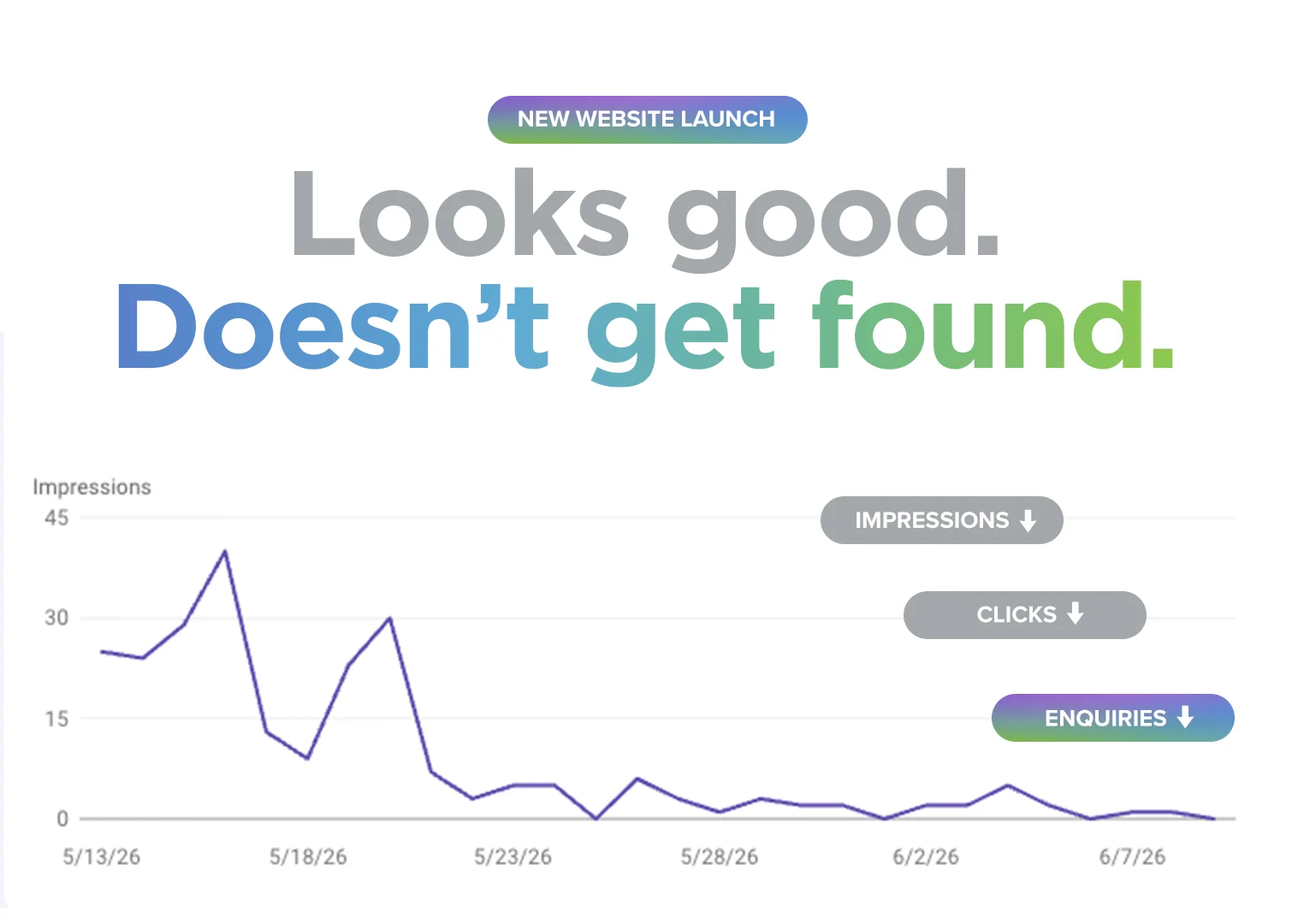
Why your new website looks great but still isn’t getting found


Let’s talk – 01435 692 023
Horam, Heathfield, East Sussex





131 trees planted
How we’re making better choices for people, planet and purpose.
On Sustainability – read more
